
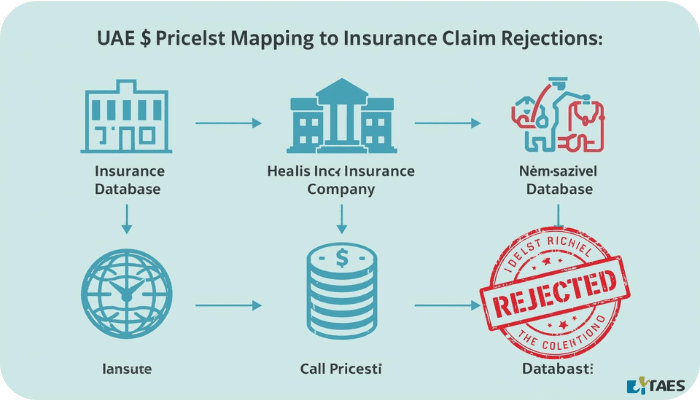
In the rapidly evolving landscape of healthcare administration in the United Arab Emirates (UAE), medical practitioners and billing departments are under intense scrutiny to ensure accurate and compliant submissions for insurance claims. Among the many challenges faced, incorrect pricelist mapping stands out as one of the leading causes of claim rejections by insurers and regulatory bodies such as the Dubai Health Authority (DHA).
In this comprehensive guide, we’ll explore:
- Common mistakes in pricelist mapping
- Key DHA rules governing pricelists and billing
- Real-world examples of pricelist mapping errors
- How Escrow Healthcare fixes these issues to improve acceptance rates
Let’s dive into why something as seemingly simple as a pricing list can make or break your revenue cycle in the UAE healthcare market.
What Is Pricelist Mapping?
Before we delve into errors and consequences, it’s essential to understand what pricelist mapping actually means.
Pricelist mapping is the process of aligning a healthcare provider’s internal service codes, treatment descriptions, and prices with the corresponding official fee schedules used by insurance payers and regulatory bodies like the DHA. This mapping must be consistent across all patient encounters to ensure accurate billing and reimbursement.
In simpler terms:
You must make sure that every service you perform is matched to a correct code and price that the insurer recognizes and accepts.
Incorrect pricelist mapping can lead to claim rejections, delayed payments, compliance risks, and wasted administrative effort—all of which harm both cash flow and patient satisfaction.
Common Mistakes in Pricelist Mapping
Let’s start with the most prevalent errors that healthcare providers make in their billing processes.
1. Incorrect or Incomplete Procedure Codes
Many clinics operate with a mix of local descriptions and legacy code systems. When these internal codes are mapped to the insurer’s pricelist, errors creep in because:
- The internal description doesn’t match the insurer’s description
- The provider selects a similar, but incorrect, code
- The code used is obsolete or no longer valid
For example, a dental clinic might use an internal code like “DENT005 – Tooth Extraction” that they’ve used for years. But the insurer’s pricelist may now differentiate between simple extraction, surgical extraction, and multiple tooth extractions—each with different reimbursement values. If mapped incorrectly, the claim will be rejected.
2. Using Generic Descriptions Instead of Exact Matches
Insurers and DHA fee schedules rely on precise descriptions. Generic terms like “Consultation”, “Therapy”, or “Lab Test” are too broad and can result in mismatches.
For example:
- “Consultation” could be for a general physician
- It could be a specialist consult
- It could be a follow-up visit
Each carries a different reimbursement code and price. Mapping them generically leads to mismatches and claim denials.
3. Not Updating Pricelist Mapping Regularly
This is one of the biggest silent killers of clean claims.
Healthcare providers often set up mapping once and forget it.
But insurers, DHA, and third-party administrators continuously update:
- Fee schedules
- Procedure codes
- Approved prices
- Coverage terms
Failing to update means that your system is submitting outdated codes that insurers no longer recognize.
This is particularly critical in the UAE, where regulatory bodies update healthcare fee schedules frequently to align with policy goals and quality standards.
4. Misinterpretation of Insurance Policies
Different insurers operate with different rules:
- Some have annual price adjustments
- Some provide special pricing for certain facilities
- Others have exclusions for specific procedures
Assuming that one pricelist fits all insurers leads to mapping errors when claims are submitted to multiple payers.
5. Human Errors & Manual Data Entry
Despite automation tools becoming more common, many clinics still rely on manual pricelist updates and billing entries. Human errors here include:
- Typos in codes
- Incorrect pricing entered
- Wrong mapping selections from dropdowns
Even small slip-ups lead to costly rejections.
Why DHA Rules Matter
In Dubai and across the UAE, the Dubai Health Authority (DHA) sets regulatory standards that govern how medical billing and insurance interactions should occur. Understanding these rules is critical to avoid claim rejections.
DHA Standardization
DHA mandates that all healthcare providers:
- Use standardized procedure codes
- Align pricing structures with approved schedules
- Maintain accurate medical records for audit
- Submit claims within regulated timeframes
This means pricelist mapping isn’t just a best practice—it’s often a regulatory requirement.
Coding Accuracy
Under DHA rules:
- Procedures must be coded using standardized nomenclature (e.g., CPT, ICD)
- Unsupported or vague codes will be rejected
- Minor discrepancies between the provider’s description and the approved code will trigger audits
DHA has the authority to impose fines or even licensing implications for repeated or intentional violations.
Compliance Audits
Healthcare facilities are periodically audited by DHA and insurers to ensure adherence to pricing standards. Any systematic mismatch between billing and approved pricelist items can result in:
- Delayed approvals
- Financial penalties
- Increased scrutiny on all future claims
So, when claims are rejected due to incorrect pricelist mapping, it isn’t merely a billing problem—it’s a compliance issue.
Real Examples of Incorrect Pricelist Mapping
Let’s look at real-world examples to understand how these mistakes play out in practice.
Example 1: Mispriced Lab Tests
Situation:
A multi-specialty clinic submitted lab tests coded under a general category instead of the specific test codes listed by DHA and insurers.
Mapping Error:
- Mapped “Complete Blood Test” as a general code
- Insurer requires separate codes for CBC, differential, platelets
Result:
- Claim rejected due to code mismatch
- The insurer raised a query asking for itemized test codes
Impact:
- Time lost in resubmission
- Delayed payment for the clinic
- Added administrative cost
Example 2: Incorrect Dental Procedure Mapping
Situation:
A dental clinic billed a surgical extraction under a simple extraction code.
Mapping Error:
- Internal code “DENT910 – Surgical Extraction”
- Mapped to insurer price for “Simple Extraction”
Result:
- Provider received a partial payment
- Or outright denial demanding correct code mapping
Impact:
- Loss of revenue
- Administrative back-and-forth
Example 3: Failure to Update After Policy Change
Situation:
An imaging facility continued to use an old price list for MRI scans even after DHA updated pricing.
Mapping Error:
- Submitting outdated rates
- Insurer flagged discrepancy between claimed price and approved price list
Result:
- Claim returned for resubmission
- Provider forced to adjust pricing and incur more work
Impact:
- Longer turnaround time
- Cash-flow challenges
How Escrow Healthcare Fixes Pricelist Mapping Issues
Now that we’ve covered common mistakes and real-world consequences, let’s look at how Escrow Healthcare solves these issues effectively and consistently.
1. Automated Mapping with Continuous Updates
Escrow Healthcare uses an advanced billing system that:
- Synchronizes with DHA fee schedules
- Auto-updates insurer price lists
- Flags mismatches instantly
This removes the risk of using outdated or incorrect codes.
Automation ensures that every service is mapped to the correct DHA-approved code and price before a claim is submitted.
2. Expert Coder Reviews
Technology alone isn’t enough. Escrow combines automation with expert certified medical coders who:
- Validate mappings
- Resolve complex cases
- Ensure compliance with insurer rules
Having trained coders review all mappings dramatically reduces rejected claims.
3. Custom Rule Engines for Each Payer
Because each insurer has a unique fee schedule and pricing rules, Escrow designs custom mapping logics for:
- DHA
- Daman
- Other private insurers
This eliminates assumption-based mapping and human guesswork.
4. Real-Time Validation and Feedback
Before claims are submitted, Escrow runs:
- Real-time price validation
- Code accuracy checks
- Risk assessments for potential rejection
This pre-submission quality check ensures claims are clean and compliant.
5. Continuous Monitoring and Reporting
Escrow doesn’t stop after submission. The system:
- Tracks claim status
- Identifies rejection patterns
- Flags recurring mapping errors
This allows proactive corrections—not reactive firefighting.
6. Training and Support for Internal Teams
Escrow Healthcare also empowers your staff by providing:
- Regular training on DHA updates
- Best practices in code selection
- Insights on insurer rules
This enhances internal capabilities and reduces dependency on external correction.
The Business Impact of Correct Pricelist Mapping
Correct pricelist mapping isn’t just about avoiding rejections—it’s about improving financial performance and operational efficiency.
Here’s how:
🔹 Faster Claim Acceptance
Clean claims result in:
- Quicker payments
- Fewer queries
- Fewer adjustments
This improves your revenue cycle.
🔹 Lower Administrative Cost
When claims are accurate:
- Less time spent on rework
- Reduced workload for billing teams
- Better operational flow
🔹 Better Compliance
Mapping consistent with DHA rules:
- Reduces audit risk
- Improves reputation with payers
- Lowers regulatory penalties
🔹 Enhanced Patient Experience
Patients benefit from:
- Fewer billing disputes
- Clearer explanations
- Less out-of-pocket confusion
This leads to higher satisfaction and trust.
Conclusion
In the UAE healthcare market, the smallest mistake—like an incorrect pricelist mapping—can have large financial consequences. With constant updates from DHA and varying insurer regulations, manual and inconsistent mapping almost guarantees claim rejections, cash flow delays, and administrative headaches.
But when you implement a systematic, technology-driven, and expert-supported mapping process, those issues disappear. That’s exactly what Escrow Healthcare provides—accurate pricelist alignment, continuous updates, insurer-specific logic, and professional coder review.
Getting this right means fewer rejections, faster reimbursements, and smoother operations—which ultimately translates into better financial health for your practice.