
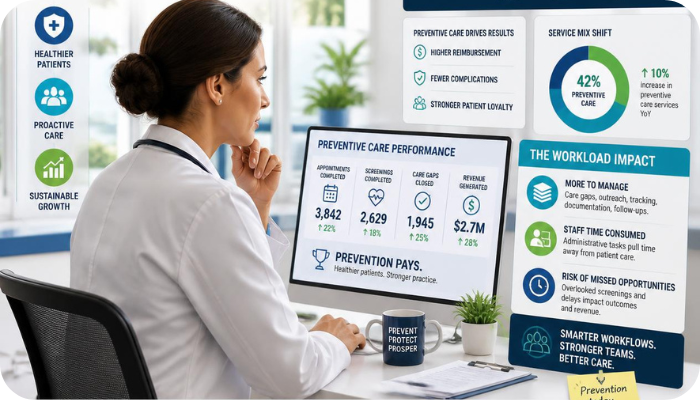
Abu Dhabi’s healthcare system is putting greater emphasis on prevention, early detection and continuity of care. The launch of Healthy Horizons for Emirati senior citizens is one recent example, offering preventive screenings, specialist-led workshops, chronic disease support, eye-health services, sleep support, mental wellbeing initiatives and pathways to further clinical care.
For hospitals and clinics, preventive healthcare is not only a clinical development. It changes the volume and complexity of activity moving through the medical billing and revenue cycle management (RCM) process.
A screening can lead to a consultation. A consultation can lead to diagnostic testing. Testing can lead to another specialist visit. That visit may generate additional procedures, prescriptions, follow-ups and insurance claims.
When these activities increase, the financial workflow behind them must remain accurate.
This is where outsourced medical billing and RCM becomes increasingly important for UAE healthcare providers.
Why Preventive Healthcare Changes the Revenue Cycle
Preventive healthcare creates a different pattern of patient activity from a single treatment episode.
A patient may enter a clinic for a health screening and subsequently require:
- Eligibility and insurance verification
- Physician consultation
- Diagnostic investigations
- Specialist referral
- Chronic disease monitoring
- Follow-up consultations
- Additional procedures
- Medication-related services
- Repeated insurance claims
- Accounts receivable follow-up
Each encounter creates information that must be documented, coded, submitted and reconciled correctly.
The Dubai Health Authority’s latest insurance-system figures show how significant this environment already is. Dubai had more than 4.9 million beneficiaries covered under its health insurance system in 2025, while insurance claims increased to approximately 49.6 million, up from 43.69 million in 2024—a 13.5% increase.
That means healthcare providers are operating in a revenue cycle where claim volume is already substantial. Preventive programmes and ongoing monitoring can add further activity to this ecosystem.
The UAE Healthcare Revenue Cycle Is Becoming More Data-Dependent
Medical billing is no longer simply about sending an invoice to an insurance company.
A healthcare encounter produces multiple pieces of information that need to remain connected:
Patient eligibility → Clinical documentation → Medical coding → Claim creation → Payer submission → Adjudication → Payment posting → Denial management → AR follow-up
If one stage is inaccurate, the problem can appear later in the cycle.
For example, incomplete clinical documentation can affect coding. Incorrect coding can affect claim submission. A claim error can result in rejection or denial. An unresolved denial can eventually become delayed reimbursement or lost revenue.
Abu Dhabi’s health insurance framework specifically addresses claims management, reimbursement, standard medical coding, data exchange and claims adjudication.
This makes medical billing RCM an operational function rather than an administrative afterthought.
The Financial Scale Makes RCM Accuracy More Important
Dubai’s healthcare expenditure reached approximately AED 24.55 billion in 2024, a 10% increase from 2023, according to the Dubai Health Authority. The private sector accounted for approximately half of total healthcare spending.
DHA data also shows that Dubai’s health insurance system handled approximately 49.6 million claims in 2025.
These numbers matter to individual healthcare providers because every clinic operates within this larger reimbursement environment.
More healthcare utilisation means more encounters to document, more services to code, more claims to monitor and more payer transactions to reconcile.
The objective is not simply to submit more claims.
The objective is to submit clean, accurate and properly supported claims and then actively manage the revenue cycle until reimbursement is received.
Where Preventive Care Can Create Billing Problems
Preventive healthcare can expose weaknesses that were already present inside a clinic’s billing workflow.
1. Eligibility Problems
A patient may arrive for a screening without the billing team having confirmed the relevant insurance eligibility or coverage conditions.
If eligibility is not checked correctly before service delivery, the provider may discover coverage problems only after the claim reaches the payer.
2. Documentation Gaps
Preventive consultations can involve multiple findings, assessments, screenings and follow-up recommendations.
If documentation does not adequately support the services reported on a claim, the billing team may face coding or payer-related issues.
3. Coding Errors
Medical coding translates clinical documentation into standardized information used for billing and reimbursement.
When coding does not accurately represent the documented service, diagnosis or procedure, the resulting claim can become vulnerable to rejection, denial or payment discrepancies.
4. Claim Submission Errors
A growing number of patient encounters means more claims entering the billing workflow.
Manual processes can make it harder to identify missing information, inconsistent data or recurring submission errors before claims reach the payer.
5. Denial Accumulation
A denial is not simply a rejected invoice.
It represents a revenue-cycle task that requires identification of the denial reason, correction or supporting documentation where appropriate, resubmission or appeal, and follow-up.
When denial queues grow faster than staff can resolve them, accounts receivable can age.
6. AR Delays
Revenue is not complete when a claim is submitted.
The provider still needs to monitor payer responses, post payments accurately, identify underpayments and follow up on outstanding balances.
This is why accounts receivable management is a critical component of medical billing RCM.
What Happens When Preventive Care Volume Increases Without RCM Capacity?
A clinic can have excellent doctors and modern diagnostic equipment while still experiencing revenue leakage because the billing workflow cannot keep pace.
Consider a clinic that increases preventive consultations.
The clinical team sees more patients.
The front desk processes more appointments.
Doctors generate more documentation.
The coding team receives more charts.
The billing team submits more claims.
The payer returns more transactions.
The AR team now has more outstanding balances to monitor.
If staffing and processes remain unchanged while encounter volume increases, the pressure eventually moves into the revenue cycle.
The result can include:
Higher billing workload → slower claim processing → larger denial queues → older AR → delayed reimbursement
The solution is not necessarily to hire more internal billing staff for every increase in patient volume.
For some UAE hospitals and clinics, outsourcing medical billing and RCM can provide additional operational capacity without requiring the provider to build every billing function internally.
Why Dubai Healthcare Providers Are Looking at Outsourced Medical Billing RCM
Dubai has a large and diverse private healthcare environment. DHA has reported extensive private-sector infrastructure covering hospitals, day-care surgery centres, diagnostic centres and specialised outpatient clinics.
At the same time, the insurance ecosystem is handling tens of millions of claims.
This creates a practical challenge for healthcare providers:
Clinical growth does not automatically produce financial growth.
The provider must convert completed healthcare services into correctly documented, coded, submitted and reimbursed claims.
An outsourced medical billing company can support this process by taking responsibility for defined parts of the revenue cycle, including:
- Insurance eligibility verification
- Medical coding
- Charge capture
- Claim preparation
- Claim submission
- Denial management
- AR follow-up
- Payment posting
- Billing audits
- Revenue-cycle reporting
The right model depends on the provider’s specialty, payer mix, claim volume, internal resources and existing billing technology.
In-House Medical Billing vs Outsourced Medical Billing RCM
When preventive healthcare increases patient encounters, healthcare providers need to decide whether their existing billing infrastructure can absorb the additional workload. Dubai’s insurance system recorded approximately 49.6 million insurance claims in 2025, up 13.5% from 43.69 million in 2024. The system also covered more than 4.9 million beneficiaries and included 3,936 healthcare providers.
| Revenue Cycle Area | Internal Billing Model | Outsourced Medical Billing & RCM Model |
|---|---|---|
| Medical Coding | Internal coders manage documentation and coding according to available staff capacity. | Dedicated coding resources can review documentation and support consistent, accurate coding workflows. |
| Claim Submission | Claim processing depends on internal workload, software and staff availability. | A specialized RCM team manages claim preparation, submission and tracking as part of a structured workflow. |
| Denial Management | Denials may compete with daily billing and administrative tasks for staff attention. | Dedicated denial-management workflows identify denial reasons, prioritize cases and coordinate corrective action. |
| Accounts Receivable | AR follow-up may become difficult when claim volume increases. | Dedicated AR teams can monitor ageing, payer responses, outstanding claims and follow-up activity. |
| Billing Audits | Audits may be performed periodically depending on internal resources. | Regular revenue-cycle reviews can identify recurring coding, documentation, claim and payment issues. |
| Scalability | Additional patient volume may require additional hiring, training and supervision. | An established RCM operation can provide additional billing capacity as healthcare activity grows. |
| Payer Follow-Up | Staff must balance payer communication with other front-office and billing responsibilities. | Payer follow-up can be handled through a dedicated workflow focused on unresolved claims and reimbursement. |
| Revenue Visibility | Management may need to collect information from multiple internal billing processes. | RCM reporting can provide visibility into claims, denials, AR ageing, payments and outstanding reimbursement. |
| Preventive-Care Growth | More screenings and follow-ups can increase workload across coding, claims and AR. | The billing infrastructure is designed to manage the financial workflow generated by increasing patient encounters. |
| Operational Focus | Healthcare providers manage clinical operations alongside billing administration. | Providers can keep greater internal focus on clinical operations while an external specialist manages agreed RCM functions. |
How Escrow Medical Billing Service Supports UAE Providers
Escrow Medical Billing Service is an outsourced medical billing and RCM company serving healthcare providers in Dubai and the UAE.
Its model is built around helping healthcare providers manage the financial workflow that follows patient care.
Escrow’s stated performance indicators include:
- 10+ years of experience
- 98% clean claim rate
- 500+ satisfied clients
For a clinic expanding preventive services, the value of an RCM partner is not simply processing more claims.
The important question is whether the revenue cycle can identify problems early, reduce avoidable claim issues, maintain AR follow-up and keep reimbursement moving.
A stronger RCM process connects clinical activity with financial outcomes.
Patient encounter → Documentation → Coding → Claim → Payer response → Denial resolution → Payment → AR reconciliation
That connection becomes increasingly important as healthcare moves toward continuous monitoring and preventive intervention.
8 Questions Hospitals and Clinics Should Ask About Preventive-Care Billing
1. Is our billing team prepared for higher preventive-care claim volume?
Preventive programmes can create repeated screenings, consultations and follow-ups rather than one-time encounters. Hospitals and clinics should measure claims per provider, coding turnaround, rejection rates, denial volume and AR ageing. If billing workload is increasing faster than internal capacity, outsourcing selected medical billing RCM functions can prevent operational bottlenecks.
2. Are our preventive services being documented strongly enough for billing?
Every billable healthcare service should be supported by appropriate clinical documentation. A preventive consultation may involve screening results, assessment, diagnosis, recommendations and follow-up. Billing teams should compare documentation with submitted codes and identify recurring gaps. Regular coding audits can reveal problems before they become repeated payer rejections or denials.
3. Are insurance eligibility checks happening before services are delivered?
Eligibility verification should be part of the front-end revenue cycle, not a task discovered after a claim fails. Hospitals and clinics should confirm coverage information, payer details and applicable requirements before service delivery whenever possible. Strong front-end verification reduces avoidable claim problems and gives patients and providers earlier visibility into coverage issues.
4. What happens to our claims after submission?
Claim submission is only one stage of medical billing RCM. Providers should track payer acknowledgements, adjudication status, rejections, denials, payments and outstanding balances. A claim that disappears into a payer queue without active monitoring can become aged AR. Dashboards and structured follow-up workflows help billing teams identify unresolved claims before they become larger revenue problems.
5. Are we measuring denial reasons rather than just denial percentages?
A denial percentage alone does not explain why revenue is being delayed. Clinics should categorize denials by root cause, such as eligibility, authorization, coding, documentation, duplicate billing or payer-specific issues. Once recurring causes are identified, the billing process can be corrected upstream. Effective denial management therefore becomes a continuous improvement function.
6. How quickly are outstanding insurance balances being followed up?
Accounts receivable becomes increasingly important when patient encounters and claims increase. Providers should segment outstanding balances by payer, ageing category, claim status and denial reason. High-value or ageing claims require structured follow-up rather than passive waiting. A dedicated AR process can identify stalled claims, underpayments and unresolved payer responses.
7. Should we outsource medical billing instead of expanding our internal team?
Outsourcing can be appropriate when claim volume increases but recruiting, training and managing a larger internal billing department is inefficient. Hospitals and clinics should compare internal costs, billing productivity, denial performance, AR ageing, technology and reporting capabilities against an outsourced RCM model. The objective should be measurable improvement in the revenue cycle, not outsourcing for its own sake.
8. Can our RCM partner support preventive healthcare growth?
An RCM partner should be able to handle changes in encounter volume without allowing claims, denials and AR queues to accumulate. Before selecting an outsourced medical billing company, healthcare providers should assess its coding capabilities, payer workflows, denial-management process, AR follow-up, reporting and healthcare-sector experience. For UAE providers, familiarity with local insurance and regulatory requirements is particularly important.
What UAE Clinics Should Do Before Expanding Preventive Services
Preventive healthcare should be supported by a revenue-cycle workflow designed before patient volume increases.
Audit the Existing Revenue Cycle
Review the last several months of claims and identify:
- Claim rejection patterns
- Denial categories
- Coding-related issues
- Payer-specific problems
- AR ageing
- Unresolved claims
- Underpayments
- Billing turnaround time
This establishes where revenue is currently being delayed.
Connect Coding With Clinical Documentation
Coding teams should not operate separately from clinical documentation.
Review whether the documentation consistently supports the services and diagnoses being reported. Recurring discrepancies should become training and audit priorities.
Strengthen Front-End Revenue Cycle Processes
Eligibility verification, patient registration and required authorization processes should be addressed before claims reach the payer.
A problem discovered before service delivery is generally easier to manage than a problem discovered after denial.
Build a Denial-Management Feedback Loop
Do not treat each denial as an isolated event.
If the same denial reason appears repeatedly, identify the upstream process creating it.
Denial → Root-cause analysis → Process correction → Staff feedback → Monitoring
This turns denial management into a revenue-improvement process.
Monitor AR by Payer and Age
A single total AR number does not provide enough information.
Separate outstanding balances by payer, age, claim status and denial reason. This allows the billing team to prioritize claims that have the greatest financial or operational impact.
The Real RCM Challenge Behind Preventive Healthcare
Healthy Horizons demonstrates how preventive healthcare can bring screening, early detection, specialist support and follow-up pathways closer to patients in Abu Dhabi.
For healthcare providers, the financial implication is straightforward:
More healthcare activity requires a revenue cycle capable of processing that activity accurately.
Dubai’s 2025 insurance data—4.9+ million beneficiaries and approximately 49.6 million claims—shows the scale of the insurance environment in which UAE providers already operate.
As healthcare shifts toward prevention, chronic disease monitoring and continuing patient engagement, hospitals and clinics cannot afford to treat medical billing as the final administrative step after care.
Medical billing RCM is the financial infrastructure connecting patient care to reimbursement.
For providers that do not want to build every billing, coding, denial-management and AR function internally, Escrow Medical Billing Service offers an outsourced RCM model focused on clean claims, reimbursement and revenue-cycle control.
With 10+ years of experience, a stated 98% clean claim rate and 500+ satisfied clients, Escrow helps UAE healthcare providers move beyond simply submitting claims toward actively managing the complete revenue cycle.
Better preventive care requires better revenue-cycle readiness.
Escrow Medical Billing Service — Outsourced Medical Billing & RCM for UAE Healthcare Providers.