
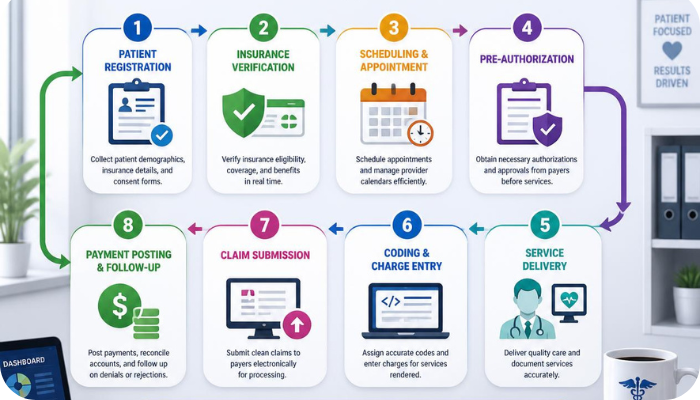
Medcare Hospitals & Medical Centres has launched an Organ Transplant Centre after completing its first successful kidney transplant at Medcare Hospital Sharjah, marking another development in the UAE’s growing advanced-care ecosystem. The development illustrates a wider operational reality for hospitals and clinics: as clinical services become more specialized, the insurance billing and revenue cycle behind those services also becomes more demanding.
Medcare’s new transplant programme reflects the UAE’s expansion of specialized healthcare services. For hospitals and clinics, advanced procedures create more complex documentation, authorization, coding, claim-submission and reimbursement workflows. Outsourced medical billing and RCM services can provide dedicated expertise for these processes while clinical teams focus on patient care. Escrow Medical Billing Service positions itself as one such RCM service UAE solution, offering medical billing, coding, denial management, AR follow-up and reimbursement support.
The UAE Healthcare Story Is Becoming More Complex
The UAE is not simply increasing healthcare capacity; it is expanding the sophistication of the services delivered.
A kidney transplant programme involves a much more complex operational chain than a routine consultation. Behind the clinical procedure are eligibility checks, insurance coordination, authorization requirements, documentation, coding, claim preparation, payer communication, payment posting and follow-up.
This matters because the volume of insurance activity is already substantial.
The Dubai Health Authority reported more than 4.9 million beneficiaries under Dubai’s health insurance system in 2025, while the number of insurance claims reached approximately 49.6 million, up from 43.69 million in 2024. That represents around 13.5% growth in claim volume in one year.
For healthcare providers, increasing claim volume does not automatically mean increasing reimbursement efficiency.
A hospital may successfully perform advanced procedures, attract more patients and expand specialties while still experiencing revenue leakage through:
- Coding discrepancies
- Missing clinical documentation
- Eligibility errors
- Authorization gaps
- Incorrect payer information
- Submission delays
- Unresolved rejected claims
- Unworked accounts receivable
- Payment reconciliation issues
Abu Dhabi’s official Shafafiya system itself illustrates how detailed the claims environment is. Its claim specifications distinguish payer information, patient share, claim amounts and denial or adjustment information, showing how much structured data sits behind an insured healthcare transaction.
Hospitals Are Built to Deliver Healthcare, Not Chase Every Unpaid Claim
This does not mean hospitals or clinics do not care about billing.
They absolutely do.
The real problem is priority and capacity.
A hospital management team has to balance physicians, nurses, patient safety, accreditation, technology, staffing, procurement, clinical outcomes, insurance relationships and regulatory requirements. A clinic owner has to manage appointments, patient experience, marketing, staffing, equipment and daily operations.
RCM is critical, but it is only one part of that workload.
That creates a familiar operational gap:
Care is delivered → claim is submitted → payment is delayed → staff become busy with the next operational issue → the unpaid balance remains unresolved.
Over time, these small gaps can become significant revenue leakage.
International healthcare evidence also shows how administrative insurance processes can consume substantial staff time. The American Medical Association’s 2025 physician survey found that physicians completed an average of 40 prior authorizations per week, while the process consumed an average of 13 hours of physician and staff time each week. The survey also found that 74% of physicians reported that prior-authorization denials had increased over the previous five years, while six in ten expressed concern that augmented intelligence could further increase denial rates. These figures are U.S. evidence, not UAE denial statistics, but they demonstrate the broader administrative burden created by payer processes.
The Hidden RCM Risk Behind Advanced Healthcare
The Medcare transplant announcement provides a useful example of why revenue cycle discipline matters.
A specialized procedure can involve:
Patient eligibility → authorization → clinical documentation → coding → claim validation → claim submission → payer adjudication → rejection management → payment posting → AR follow-up
A breakdown at any point can delay reimbursement.
For example, an inaccurate procedure code may create a claim problem. Missing documentation can trigger a request for additional information. A payer mismatch can prevent payment. An unresolved rejection can later become aged accounts receivable.
The clinical service may have been completed successfully, but the financial transaction has not necessarily reached completion.
That is the difference between revenue generated and revenue collected.
Outsourced Medical Billing as a Dedicated RCM Layer
Outsourcing does not mean every hospital should abandon its internal billing team.
It means healthcare providers can use a specialized external team where additional capacity, expertise or process control is required.
A practical model looks like this:
| RCM Stage | Internal Operational Risk | Outsourced Medical Billing Solution |
|---|---|---|
| Eligibility verification | Staff workload and missed checks | Dedicated eligibility verification |
| Prior authorization | Delays and repeated payer communication | Authorization support and tracking |
| Medical coding | Coding errors or inconsistent review | Specialist coding validation |
| Claim submission | Incorrect or incomplete claims | Pre-submission quality checks |
| Rejected claims | Staff may prioritize new work | Dedicated rejection correction |
| Denial management | Appeals and follow-up can accumulate | Root-cause analysis and resubmission |
| Accounts receivable | Older balances can remain unworked | Structured AR follow-up |
| Payment posting | Manual reconciliation workload | Payment posting and reconciliation |
| RCM reporting | Limited management visibility | KPI and performance reporting |
| Revenue optimization | Problems identified too late | Continuous RCM monitoring |
This is why outsourced medical billing UAE is increasingly relevant as a business model.
The objective is not simply to send invoices faster. It is to create a dedicated revenue cycle workflow that continues operating while the healthcare organization concentrates on clinical and operational priorities.
Where Escrow Medical Billing Service Fits
Escrow Medical Billing Service is one outsourced medical billing and RCM service UAE provider positioned around this model.
Its published service portfolio includes insurance eligibility verification, claim submission, medical coding, denial management, accounts receivable follow-up, payment posting and revenue-cycle reporting. The company says it supports healthcare providers across the UAE and operates with DHA-aligned billing processes.
Escrow also publishes the following performance figures:
- 98% clean claim rate
- Claim denials maintained between 2–10%
- 93% client retention
- Reduced payment delays
- HIPAA-compliant processes
These are Escrow-published company claims, rather than independent industry benchmarks.
Its service model is built around a simple business proposition:
Fewer Denials. Faster Payments. Higher Revenue.
Why Specialized RCM Teams Can Be More Up to Date
Insurance billing is not static.
Payer requirements, coding practices, authorization workflows, documentation expectations, claim formats and regulatory requirements can change. UAE healthcare providers therefore need teams that continuously monitor the revenue-cycle side of healthcare.
The UAE’s official claims infrastructure provides a useful illustration. The Department of Health Abu Dhabi maintains structured claim terminology covering payer identification, patient responsibility, claim values and denial or adjustment codes.
Outsourcing allows a provider to access people whose primary responsibility is staying current with these workflows.
That is the strategic difference.
A clinic’s internal staff may be capable of billing, but an RCM company is designed around billing as its core operating function.
The Escrow Problem-Solution Model
Escrow’s published approach can be framed as a simple four-stage model:
1. Identify Revenue Leakage
Review:
- Claim rejection patterns
- Denial reasons
- Coding issues
- Documentation gaps
- AR ageing
- Payment delays
- Payer-specific issues
2. Validate Before Submission
Claims can be checked for:
- Patient eligibility
- Authorization
- Coding accuracy
- Required documentation
- Payer information
- Claim completeness
3. Recover Unpaid Revenue
Once a claim is rejected or denied, the work continues through:
- Root-cause analysis
- Claim correction
- Resubmission
- Payer follow-up
- Appeals where appropriate
- AR recovery
4. Measure the Revenue Cycle
Management can track:
- Clean claim performance
- Denial rate
- AR ageing
- Payment turnaround
- Claim volume
- Outstanding balances
- Revenue recovery
This converts billing from a back-office task into a measurable revenue-cycle function.
Supporting Statistics Healthcare Leaders Should Watch
The UAE market already shows why RCM capacity matters. Dubai’s health insurance system processed approximately 49.6 million claims in 2025, a 13.5% increase from the previous year.
The international administrative burden is also significant. AMA data reports 40 prior authorizations per physician per week and approximately 13 hours of physician and staff time weekly spent on the process.
Meanwhile, healthcare revenue-cycle organizations increasingly track denial performance as a specific KPI. HFMA defines initial denial rate as the number of initial denied claims divided by claims submitted, highlighting the importance of standardized denial measurement and benchmarking.
These statistics do not establish a UAE-wide denial rate. Instead, they demonstrate why healthcare organizations should measure claim quality, administrative workload and reimbursement performance rather than treating billing as an afterthought.
In-House vs Outsourced Medical Billing
| Factor | In-House Billing | Outsourced Medical Billing |
|---|---|---|
| Staffing | Dependent on internal hiring | Access to dedicated specialists |
| Scalability | Can become difficult during claim-volume growth | Easier to scale team capacity |
| Coding expertise | Depends on internal staff | Specialist medical coding resources |
| Denial follow-up | Competes with other daily tasks | Dedicated denial workflow |
| AR management | May become inconsistent | Structured follow-up process |
| Technology | Provider bears implementation burden | Vendor may provide billing technology and workflows |
| Regulatory monitoring | Internal responsibility | Specialized compliance support |
| Management focus | Billing competes with clinical operations | Internal team can focus on core operations |
| Cost structure | Salaries, training and systems | Outsourced service model |
| Best use case | Organizations with strong dedicated RCM infrastructure | Providers seeking additional capacity or specialist expertise |
Neither model is automatically superior for every provider.
The important question is whether the current RCM operation is consistently capturing, submitting, following and collecting revenue.
FAQs for UAE Clinics
What does an outsourced medical billing company do in the UAE?
An outsourced medical billing company manages insurance-related revenue cycle activities for healthcare providers. Services may include eligibility verification, authorization support, medical coding, claim submission, rejection correction, denial management, accounts receivable follow-up, payment posting and reporting. This allows clinics to access specialized billing expertise without managing every RCM function internally.
Why do UAE clinics experience delayed insurance reimbursements?
Payment delays can arise from incomplete documentation, incorrect coding, eligibility problems, authorization gaps, claim submission errors, payer requests and unresolved rejections. A structured revenue cycle process identifies these issues before submission and monitors outstanding claims afterward, reducing avoidable delays and helping providers maintain more predictable reimbursement and cash-flow performance.
Is outsourced medical billing suitable for hospitals with an internal billing team?
Yes. Outsourcing does not necessarily require replacing an internal team. A hospital can outsource selected functions such as coding audits, denial management, AR follow-up or claim validation while retaining internal billing operations. This hybrid model can add specialized capacity where workload, staffing constraints or growing claim volumes create operational pressure.
How does RCM outsourcing help reduce claim denials?
RCM outsourcing can reduce preventable denials by combining eligibility checks, authorization verification, coding review, documentation validation, claim-quality checks and post-denial analysis. The key is not simply resubmitting rejected claims; it is identifying recurring root causes and correcting the workflow so similar errors are less likely to happen again.
Is Escrow Medical Billing Service only for hospitals?
No. Escrow positions its outsourced medical billing and RCM services for clinics, hospitals and other healthcare providers across the UAE. Its published services include medical billing, coding, insurance claim processing, denial management, AR follow-up and revenue optimization.
What Medcare’s Transplant Expansion Means for the Wider RCM Market
The significance of Medcare’s kidney transplant milestone extends beyond one hospital.
As UAE providers expand advanced services, the complexity of their financial workflows expands alongside them.
For healthcare leaders, the question is not simply:
“Are we submitting our claims?”
The more important questions are:
Are claims clean?
Are denials being analyzed?
Are unpaid claims being followed up consistently?
Are authorization and documentation issues identified early?
How much revenue is sitting in unresolved AR?
A sophisticated clinical operation needs an equally disciplined financial operation.
Outsourced medical billing is therefore not a replacement for healthcare leadership. It is an additional operational layer that can help hospitals and clinics protect reimbursement while their internal teams focus on patients, physicians, technology and growth.
For UAE providers evaluating an RCM service UAE, the right benchmark is not simply the lowest billing cost. It is whether the partner can produce a measurable improvement in claim quality, denial management, reimbursement speed, AR performance and revenue visibility.
That is where the business case for specialized RCM becomes clear:
Fewer Denials. Faster Payments. Higher Revenue.
Escrow Medical Billing Service positions its UAE offering around that outcome, with a published 98% clean claim rate, 2–10% claim-denial target range, 93% client retention, reduced payment delays and end-to-end medical billing and RCM support. These figures should be evaluated alongside a provider’s own baseline metrics through an RCM audit.