

Medical billing directly impacts how quickly you get paid, the accuracy of claims, and the financial health of healthcare practices. A single coding mistake, missing insurance documents, or a delayed claim submission can disrupt cash flow and add administrative strain. As healthcare rules, payer needs, and coding updates continue to change, many providers are reevaluating whether their in-house billing department can keep up.
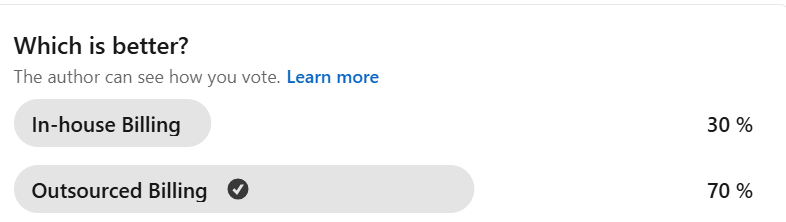
A recent LinkedIn poll on In-House Medical Billing versus Outsourced Medical Billing shows this change in thinking within the industry. About 70% of respondents preferred outsourced medical billing, while 30% favored in-house billing. Although this poll reflects opinions rather than scientific findings, it reveals a growing trend among healthcare professionals to seek out specialized medical billing partners who can improve operational efficiency, lower claim denials, and enhance revenue cycle performance.
For healthcare providers looking for a medical billing company in Dubai, outsourcing provides access to seasoned medical billers, certified coders, and dedicated revenue cycle management professionals. They do this without the constant stress of hiring, training, and keeping an internal billing team.
At Escrow Medical Billing, outsourcing relies on experts with specific roles. Instead of having one employee handle everything, specialists focus on distinct areas like medical billing, coding, revenue cycle management, insurance claim processing, and correcting claims. This organized approach ensures that each claim gets the attention it needs before submission, lowering preventable billing problems and improving reimbursement accuracy.
Why Healthcare Practices Are Moving Away from In-House Medical Billing
Over the last decade, healthcare billing has become much more complicated. Insurance companies often update billing guidelines, coding standards change each year, and documentation needs grow. Handling these duties internally can lead to operational hurdles that impact both revenue and patient care.
Many clinics set up in-house billing departments thinking it gives them better control. However, keeping billing quality high requires ongoing investments in skilled staff, coding training, payer updates, compliance checks, billing software, and internal quality checks.
When these resources are scarce, billing performance typically suffers.
In-House Medical Billing vs. Outsourced Medical Billing
| Feature | In-House Medical Billing | Outsourced Medical Billing |
|---|---|---|
| Billing Team | Limited internal staff | Dedicated medical billers, coders, and RCM specialists |
| Medical Coding | Depends on available staff expertise | Specialized medical coding professionals review documentation |
| Claim Submission | Can be delayed during busy periods | Organized workflow supports timely claim submission |
| Insurance Knowledge | Internal team manages updates | Experienced professionals work with multiple insurance requirements |
| Claim Denial Management | Limited resources for follow-up | Dedicated experts review, correct, and resubmit unsuccessful claims |
| Staff Training | Continuous investment required | Managed by the medical billing company |
| Employee Turnover | Can disrupt billing operations | Stable team with defined responsibilities |
| Revenue Cycle Management | Shared among internal employees | Separate RCM specialists monitor the complete revenue cycle |
| Quality Review | Often one-stage review | Multiple levels of claim verification |
| Administrative Burden | High | Reduced for healthcare providers |
Common Problems with In-House Medical Billing
Limited Billing Expertise
Many healthcare practices rely on a small billing team responsible for each stage of the revenue cycle. The same workers often handle:
- Insurance verification
- Medical coding
- Charge entry
- Claim submission
- Payment posting
- Accounts receivable follow-up
- Denial management
Juggling multiple roles increases their workload and cuts down the time available to check coding accuracy or payer-specific billing needs.
Frequent Medical Coding Errors
Medical coding demands a thorough understanding of:
- ICD-10-CM diagnosis coding
- CPT procedure coding
- HCPCS Level II coding
- Modifier usage
- Insurance documentation needs
Even experienced billing staff can make mistakes when workloads spike or payer guidelines shift.
Incorrect coding can lead to:
- Claim rejection
- Claim denial
- Reduced reimbursement
- Payment delays
- Extra administrative work
Accurate coding is essential for successful medical billing.
Staff Turnover Disrupts Revenue
Replacing skilled medical billers can be costly and time-consuming.
Healthcare practices often face:
- Hiring delays
- Training costs
- Loss of productivity
- Gaps in knowledge
- Increased claim backlog
During staff changes, billing queues may grow while insurance reimbursements slow down.
Disruptions in billing operations can directly impact a practice’s cash flow.
Insurance Rule Changes Require Continuous Learning
Different insurance payers have unique billing requirements.
Billing teams must keep up with:
- Authorization needs
- Claim submission deadlines
- Documentation standards
- Modifier policies
- Guidelines for medical necessity
Keeping an internal team informed means providing ongoing training throughout the year.
Without regular education, billing mistakes can rise.
Delayed Claim Submission
Medical claims should be sent right after patient visits.
However, internal teams often face delays due to:
- High patient volume
- Staffing shortages
- Manual document reviews
- Coding backlogs
- Administrative burdens
Late submissions can lead to delays in payments and may even exceed payer filing limits.
High Claim Denial Rates
Claim denials usually stem from several issues.
Common causes include:
- Missing documents
- Incorrect diagnosis codes
- Incorrect procedure codes
- Invalid modifiers
- Insurance eligibility issues
- Duplicate claims
- Incomplete patient information
Each denied claim needs investigation, correction, and resubmission, which raises administrative costs.
Limited Quality Review Process
Many in-house teams submit claims after only one review because they lack sufficient staffing.
Without multiple verification levels, small errors can go unnoticed until the insurance company rejects the claim.
Frequent denials hurt billing efficiency and delay payments.
How Outsourced Medical Billing Solves These Challenges
Outsourced medical billing replaces a broad approach with an organized workflow run by dedicated specialists.
Rather than assigning every responsibility to one employee, experienced medical billing firms use specialists for each stage of the revenue cycle.
At Escrow Medical Billing, tasks are divided among professionals with expertise in specific areas.
This structured approach includes:
Dedicated Medical Billers
Medical billers focus on:
- Charge entry
- Preparing insurance claims
- Claim submission
- Payment posting
- Following up with insurance
Their main goal is to ensure accurate claim processing and prompt payments.
Dedicated Medical Coders
Medical coders analyze clinical documents and assign the right:
- ICD-10 diagnosis codes
- CPT procedure codes
- HCPCS codes
- Required modifiers
Accurate coding boosts clean claim rates and cuts down on avoidable denials.
Dedicated Revenue Cycle Management (RCM) Specialists
RCM goes beyond submitting claims.
RCM specialists track:
- Outstanding claims
- Accounts receivable
- Insurance responses
- Payment patterns
- Denial resolution
Ongoing monitoring helps practices spot revenue gaps before they grow into serious issues.
Insurance Claim Correction Experts
Not every medical claim gets immediate approval.
Insurance companies may reject claims for reasons like:
- Missing documents
- Coding errors
- Lack of patient information
- Specific payer formatting rules
Instead of letting rejected claims sit unresolved, specialists review unsuccessful claims, identify issues, correct the documents, and prepare them for resubmission when needed.
This organized correction method helps improve reimbursement performance and reduces unnecessary revenue loss.
Multiple Levels of Claim Review
Quality checks enhance billing accuracy.
Rather than relying on a single review, specialized staff verifies various aspects before submission.
This process minimizes avoidable mistakes related to:
- Diagnosis coding
- Procedure coding
- Insurance information
- Completeness of documentation
- Billing compliance
Extra reviews boost claim quality before they reach the insurance payer.
Better Support for Multiple Insurance Payers
Healthcare providers often deal with many insurance companies.
Each payer may have different requirements for:
- Coding
- Documentation
- Authorization
- Billing format
- Filing deadlines
A dedicated medical billing company gains experience managing diverse insurance needs across multiple payers, lightening the administrative load for healthcare providers.
Why Many Healthcare Providers Prefer Outsourced Medical Billing
The LinkedIn poll showing 70% support for outsourced medical billing reflects a practical trend in the industry.
Healthcare providers increasingly understand that medical billing requires specialized knowledge in coding, insurance processing, compliance, denial management, and revenue cycle monitoring.
Instead of enlarging internal administrative teams, many practices prefer specialized medical billing companies that can handle these tasks with dedicated professionals and structured workflows.
For providers looking for a medical billing company in Dubai, outsourcing offers specialized billing expertise without the ongoing hassles of hiring, employee turnover, continuous coding education, and internal quality management.
Common In-House Medical Billing Problems and How Outsourcing Solves Them
| In-House Billing Challenge | How Outsourced Medical Billing Helps |
|---|---|
| Staff shortages | Dedicated medical billing professionals handle daily billing operations |
| Medical coding errors | Experienced medical coders review ICD-10, CPT, and HCPCS codes |
| Increasing claim denials | Claims are reviewed, corrected, and resubmitted by dedicated experts |
| Slow reimbursement | Organized claim processing supports faster reimbursement cycles |
| Insurance documentation issues | Specialists verify documentation before claim submission |
| Revenue cycle gaps | Dedicated RCM professionals continuously monitor billing performance |
| Administrative workload | Healthcare providers spend less time managing billing tasks |
| Employee turnover | Billing continuity is maintained through specialized teams |
| Multiple insurance requirements | Experts manage payer-specific billing guidelines and documentation |
| Billing quality control | Multiple review stages improve claim accuracy before submission |
Frequently Asked Questions
- Why do healthcare providers outsource medical billing?
Healthcare providers outsource medical billing to enhance claim accuracy, reduce administrative workload, strengthen revenue cycle management, and maintain reliable insurance claim processing. Specialized billing teams handle coding, billing, payment posting, denial follow-up, and reimbursement tasks more effectively than many in-house departments.
- Is outsourced medical billing better than in-house billing?
Outsourced medical billing often gives access to specialized medical billers, coders, and revenue cycle professionals. This organized approach can lower coding errors, boost claim quality, and ensure more reliable payments than smaller in-house billing teams juggling multiple tasks.
- What are the biggest challenges of in-house medical billing?
Common challenges include staff shortages, employee turnover, coding updates, changes in insurance policies, delays in claim submission, rising claim denials, and limited quality checks. These problems can slow down reimbursements and raise administrative costs for healthcare providers.
- How does medical coding affect reimbursement?
Medical coding translates clinical documents into standardized diagnosis and procedure codes. Accurate ICD-10, CPT, and HCPCS coding supports proper claim submission. Mistakes in coding can lead to claim rejection, payment delays, or lower reimbursements from insurance companies.
- What does Revenue Cycle Management include?
Revenue Cycle Management covers insurance verification, medical coding, charge entry, claim submission, payment posting, accounts receivable follow-up, denial management, and reimbursement monitoring. Every step is crucial for maintaining a well-organized and financially stable healthcare billing process.
- Can outsourced billing manage denied insurance claims?
Yes. Dedicated billing specialists evaluate denied claims, find billing or document issues, apply necessary corrections, and get claims ready for resubmission when applicable. This process helps recover revenue that might otherwise go unpaid.
- Why is a dedicated billing team important?
Dedicated professionals concentrate on specific tasks instead of managing every billing duty at once. Separate medical billers, coders, and revenue cycle specialists provide extra oversight, enhance workflow organization, and improve billing accuracy throughout the claim process.
- Why choose a medical billing company in Dubai?
Healthcare providers working with a medical billing company in Dubai can tap into specialized billing knowledge, organized revenue cycle management, experienced coding professionals, and dedicated support for insurance claims while reducing the operational demands tied to running a full in-house billing department.
Conclusion
The rising preference for outsourced medical billing reflects the growing complexity of healthcare reimbursement. As shown by the LinkedIn poll, many healthcare professionals see the benefits of outsourcing in meeting these challenges.